
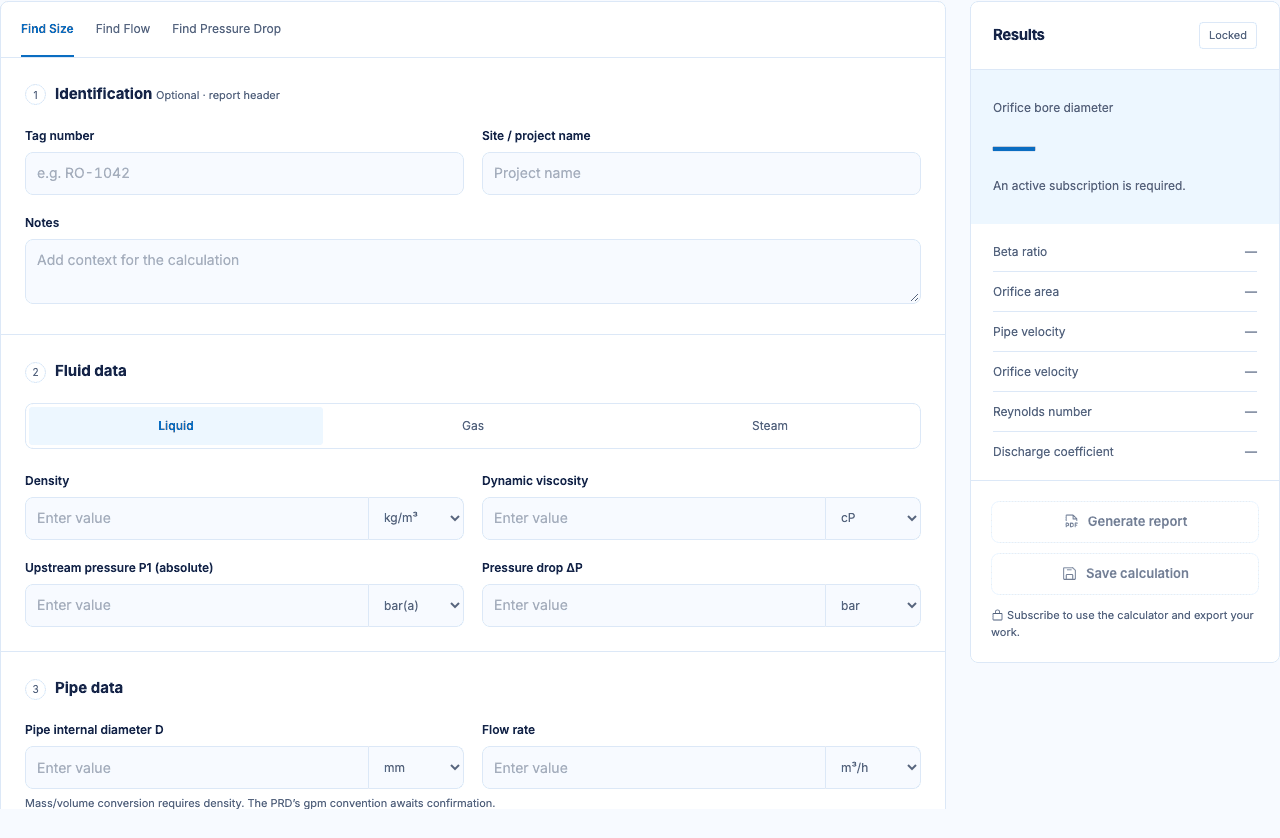
Find Size
Determine the required restriction-orifice bore for specified conditions.
You provide:
- Flow conditions
- Pipe geometry
- Fluid properties
- Operating conditions
We calculate:
✓ Required bore

Engineering tools for real-world process applications
Explore restriction-orifice size, flow rate and pressure drop for liquid, gas and steam applications using a professional engineering workflow.
Explore fields and units. Entered values stay in this preview; no calculation is run. The paid workspace adds live results, project design basis, liquid duty scenarios, RHG audit, plate screening, saved records and engineering reports.
Choose the calculation that matches your engineering requirement.
Determine the required restriction-orifice bore for specified conditions.
✓ Required bore
Calculate flow through a known restriction orifice.
✓ Flow rate
Determine the pressure drop across a known restriction orifice.
✓ Pressure drop
Apply the calculator to a wide range of process applications.

Incompressible-fluid workflows with density and viscosity inputs.

Compressible-gas workflows for real process conditions.

Steam workflows for process applications.
See the source water example with typical process inputs.
Review method applicability
Static water example for illustration. Final results depend on the approved engineering method and process conditions.
How it works
A simple, guided workflow to help you calculate, validate and document
with confidence.
Input your process and
fluid data.
Get instant results with
engineering checks.
Keep your calculations
for future reference.
Prepare a professional
PDF report.
Learn about the calculations, assumptions and engineering approach behind the calculator.
View MethodologyReview the limitations and required engineering checks before applying results to a design.
Read DisclaimerFrom inputs to an engineering record
The primary result answers your selected mode. Supporting values show bore geometry, flow regime and velocities.
Results and engineering warnings remain subject to the approved method and operating limits.
Worked example · Water
A supplied water case, reproduced at the brief’s published precision.
37.86 mm bore
The brief’s proposed constant-Cd liquid method gives β = 0.3786, area = 1,125.56 mm² and Re ≈ 176,485. Pipe and throat velocities are approximately 1.77 m/s and 12.34 m/s.
This static example does not use any values entered in the preview above.
Read the methodology statusEngineering notice. This source example has been arithmetically checked, but does not establish an approved production methodology. Review remains required before design use. Engineering disclaimer →
Keep the context with the calculation
Subscribers can calculate, save and export results. Saved records remain readable when a subscription expires.
Explore the full workflowTransparent engineering methodology
The brief proposes a constant discharge-coefficient method for restriction-orifice flow, with an expansibility correction for gas and steam. Reynolds number and choking checks are part of the specified output.
Choose the constant-Cd method or the liquid RHG method. Dry steam uses IF97 properties. Review applicability warnings; calculation results do not certify an installation.
Practical answers about inputs, access and engineering review.
The three modes are Find Size, Find Flow and Find Pressure Drop. They solve for bore diameter, flow through a known orifice, or pressure drop. The preview explains these workflows; subscribers can calculate with the constant-Cd or liquid RHG method.
The product brief specifies liquid, gas and steam. Each has its own input structure. Gas-property methods and the IAPWS-IF97 steam adapter require approval before production calculations are enabled.
Yes. The preview includes mm/in, bar/psi, density, viscosity and temperature units from the brief. Units stay beside each value. Mass-to-volume flow conversion requires density, and the brief’s unqualified gpm convention is awaiting confirmation.
Subscribers can save and reopen calculations. Signed-in users retain read access to their existing records if a subscription lapses.
Subscribers can export individual and combined branded PDF reports with inputs, results, methodology and warnings.
You can inspect modes, fluids and units, and read this page without paying. Authoritative calculations, saving results and exporting reports require an active subscription. Pricing and checkout are awaiting configuration.
The product brief and methodology guide describe the proposed approach. Calculation records are designed to retain an engine version for traceability. The final production method and operating limits require engineering sign-off.
Create your Adriel Engineering account and explore the workspace.
Subscribe through Paystack for calculations, saved records and PDF reports.